


How to Choose an Optimized New Perfume Vending Machine

- Selecting a High-Performance Fragrance Dispensing Kiosk
- Procurement criteria that determine project success
- Critical hardware features and modularity
- Connectivity and payment architecture
- Operational and Commercial Considerations for Deployment
- Inventory management, refill planning, and SKU rotation
- Site selection, ergonomics, and user experience
- Regulatory compliance and hygiene standards
- Technical Specifications, Testing, and Quality Assurance
- Durability testing and component lifecycle
- IoT telemetry, data architecture, and remote operations
- Energy consumption, noise, and maintenance scheduling
- Why choose MAKMIK for fragrance dispensing solutions
- Manufacturing capacity and strict quality controls
- Product portfolio: modular dispensers and customization
- Software ecosystem, connectivity, and lifecycle support
- Competitive advantages and industry credibility
- Frequently Asked Questions
The selection process for an advanced fragrance dispensing kiosk requires a convergence of hardware resilience, cloud-native vending software, payment and telemetry integration, and compliance with safety and quality standards; procurement teams should prioritize systems that provide real-time stock telemetry, multi-channel payments, modular refill units, and measurable uplift in conversion while validating supplier credentials via industry standards and IoT best-practices to minimize total cost of ownership.
Selecting a High-Performance Fragrance Dispensing Kiosk
Procurement criteria that determine project success
Buyers should start with functional requirements that directly map to commercial KPIs: SKU capacity per dispenser, shots-per-refill, expected daily transactions, and supported payment rails. Contracting teams must specify service-level targets for uptime, mean-time-to-repair (MTTR), and accuracy rates for scent dispenses. Include acceptance criteria for factory testing and site commissioning to ensure delivered units meet contractual throughput and reliability metrics.
Critical hardware features and modularity
Robust mechanical design reduces service visits. Look for separate modules for perfume reservoirs, pump assemblies, and nozzle arrays so a single failed component can be swapped without replacing the entire unit. Materials should be chemically compatible with alcohol-based fragrances; stainless steel or IP-rated polymer housings extend life in public areas. Confirm the dispenser supports hot-swap refill cartridges and that nozzle design limits aerosol drift to maintain consistent dosing.
Connectivity and payment architecture
Modern unattended fragrance kiosks must support multi-protocol connectivity: 4G/5G cellular fallback, dual-band Wi‑Fi, and Ethernet for fixed sites, plus Bluetooth Low Energy (BLE) for proximate diagnostics. Payment stack should include EMV card readers, NFC/mobile wallets, and remote voucher/coupon redemption. Ensure the provider adheres to payment security standards (e.g., PCI DSS) and that telemetry is encrypted end-to-end to protect transaction and inventory data.
Operational and Commercial Considerations for Deployment
Inventory management, refill planning, and SKU rotation
Inventory telemetry transforms refill logistics from calendar-based to demand-driven. Systems that report shots dispensed per SKU, remaining milliliters, and estimated days-to-empty allow operators to optimize routes and reduce emergency service calls. Prioritize dispensers that provide predictive refill alerts and support batch-level tracking to manage expiry and lot recalls.
Site selection, ergonomics, and user experience
Placement impacts conversion: high footfall retail corridors, airport duty-free areas, High Quality hotel lobbies, and experiential stores deliver different dwell times and purchase intents. The user interface should support quick trials, clear scent descriptions, sample dosing, and upsell prompts; consider integrated digital displays for rich media and QR-code driven campaigns to capture opt-ins for remarketing.
Regulatory compliance and hygiene standards
Fragrance dispensing systems that aerosolize liquids must comply with local fire and chemical safety regulations. For enterprise procurement, require conformity documentation: material safety data sheets (MSDS) for consumables, electrical safety certifications, and documented cleaning/maintenance protocols. For hygiene guidance and public health alignment, consult global standards on indoor air quality and sanitation practices as relevant to installation contexts; see World Health Organization for public health considerations.
Technical Specifications, Testing, and Quality Assurance
Durability testing and component lifecycle
Require test reports for lifecycle cycles (actuation cycles, pump longevity, and connector durability). Vendors should provide accelerated aging results and a clear spare-parts BOM. Request factory acceptance test (FAT) results that include dispense volume variance, nozzle clog rates, and unit ingress protection rating. Quality management processes certified to recognized standards reduce supplier risk; see ISO 9001 for quality system expectations.
IoT telemetry, data architecture, and remote operations
An enterprise-ready kiosk will expose APIs for inventory, transaction logs, device health, and remote configuration. Preferred architectures use MQTT or RESTful services with TLS encryption and role-based access control for administrative functions. Align on data retention policies, SLA for data delivery, and dashboards for business intelligence. For IoT architecture and best practices, industry guidance from technical bodies is recommended; review resources such as IEEE IoT.
Energy consumption, noise, and maintenance scheduling
Energy credentials are a practical procurement filter—specify average power draw in standby and active dispense modes, and confirm if the system supports power-saving sleep modes. Noise levels should be measured at typical operating distances to preserve ambient retail comfort. Insist on a preventive maintenance schedule with clear parts-life metrics and remote diagnostics to reduce on-site MTTR.
| Characteristic | Legacy coin/card kiosk | Connected fragrance dispenser |
|---|---|---|
| Payment options | Coins, magnetic stripe | EMV, NFC, mobile wallets, vouchers |
| Inventory visibility | On-site manual checks | Real-time telemetry, SKU-level reporting |
| Downtime diagnostics | Technician visit required | Remote fault reporting, OTA updates |
| Refill planning | Calendar-based | Demand-driven with predictive alerts |
| Revenue uplift | Baseline retail conversion | Reported increases due to personalization and cashless convenience |
Why choose MAKMIK for fragrance dispensing solutions
Manufacturing capacity and strict quality controls
MAKMIK is a high-tech enterprise focused on delivering integrated software and hardware solutions for smart unattended retail. With more than 10 years of R&D and production experience in IoT and unmanned retail, our manufacturing process includes fully automatic assembly lines, CNC machining centers, laser cutting, and automated welding to ensure component precision and repeatability. Our production footprint exceeds 20,000 square meters and allows scalable manufacturing of thousands of units annually while enforcing rigorous quality inspections and FAT procedures.
Product portfolio: modular dispensers and customization
Our product family includes specialized fragrance kiosks, beauty vending cabinets, beverage dispensers, and fresh-food units tailored for different retail scenarios. The fragrance solutions support both concentrated-cartridge and spray-nozzle architectures, enabling buyers to select between compact perfume vending systems for High Quality sampling and larger-scale spray dispensers for high-traffic locations. Modular cartridge design simplifies refilling and reduces service times, while software-configurable dispense volumes enable precise cost control per trial.
Software ecosystem, connectivity, and lifecycle support
We provide a cloud platform for remote monitoring, transaction reconciliation, OTA firmware updates, and analytics dashboards that translate telemetry into route-optimization and SKU recommendations. Our after-sales framework includes remote diagnostics, spare-parts inventory support, and extended warranty options. For enterprise procurement, our teams can deliver bespoke integrations to existing POS and loyalty systems and provide documented APIs for BI ingestion to maximize ROI.
Competitive advantages and industry credibility
MAKMIK combines a decade of technical expertise with a global customer base for its fragrance dispensers. Buyers benefit from proven production throughput, a large skilled technical workforce, and an emphasis on compliance and test evidence. Our devices are engineered for long operational life and easy field maintenance, reducing lifecycle costs and improving uptime for site operators. For technical inquiries and product specifications, visit MAKMIK.
Relevant industry standards and resources inform selection and contracting decisions; for background on vending automation and historical context see Vending machine — Wikipedia, for quality management frameworks see ISO 9001, and for IoT architectural guidance consult IEEE IoT.
Procurement teams that require sample units, FAT documentation, and pilot deployment metrics should request site-level proof-of-concept programs and measurable KPIs before scaling a national or international roll-out.
Contact and procurement checkpoints should mandate delivery of test reports, certificate copies, and a defined escalation matrix for service-level enforcement.
Purchase agreements should include acceptance tests for dispensing accuracy, connectivity resilience, payment security compliance, and a defined warranty and spare-parts SLA to protect operational continuity.
By evaluating vendors against these technical, operational, and commercial criteria, buyers can select a fragrance dispensing solution that optimizes consumer experience while maintaining predictable operational costs and measurable revenue uplift.
MAKMIK supports enterprise customers through pilot programs, bespoke integration, and long-term lifecycle management to ensure deployed scent-dispensing ecosystems meet agreed business outcomes.
Frequently Asked Questions
What are the must-have technical features for an enterprise fragrance dispenser?
Essential technical features include modular refill cartridges, multi-protocol connectivity (4G/5G, Wi‑Fi, Ethernet), encrypted telemetry APIs, EMV-compliant payment acceptance, remote diagnostics, and documented factory acceptance test (FAT) results for dispense accuracy and lifecycle testing.
How does real-time inventory telemetry improve refill logistics?
Real-time telemetry converts refill programs from calendar-based schedules to demand-driven operations, enabling predictive route planning, fewer emergency service calls, optimized stock levels, and reduced stock-outs through alerts for low-reserve thresholds at the SKU level.
Which certifications and documentation should be requested from suppliers?
Buyers should request quality management certificates (e.g., ISO 9001), electrical safety and EMC certificates, material safety data sheets (MSDS) for consumables, PCI compliance evidence for payment modules, and detailed FAT and accelerated lifecycle test reports.
What connectivity and security practices are recommended for unattended kiosks?
Recommended practices include support for redundant connectivity (cellular/Wi‑Fi), encrypted data transport (TLS), API-based access with role-based controls, secure OTA firmware management, and adherence to payment security standards such as PCI DSS for transaction handling.
How should total cost of ownership (TCO) be evaluated for fragrance vending deployments?
TCO evaluation should include initial hardware and integration costs, expected refill and consumables costs (shots per refill), preventive maintenance and spare-parts expenses, predicted downtime impact on revenue, and incremental uplift from cashless payment and personalization features.
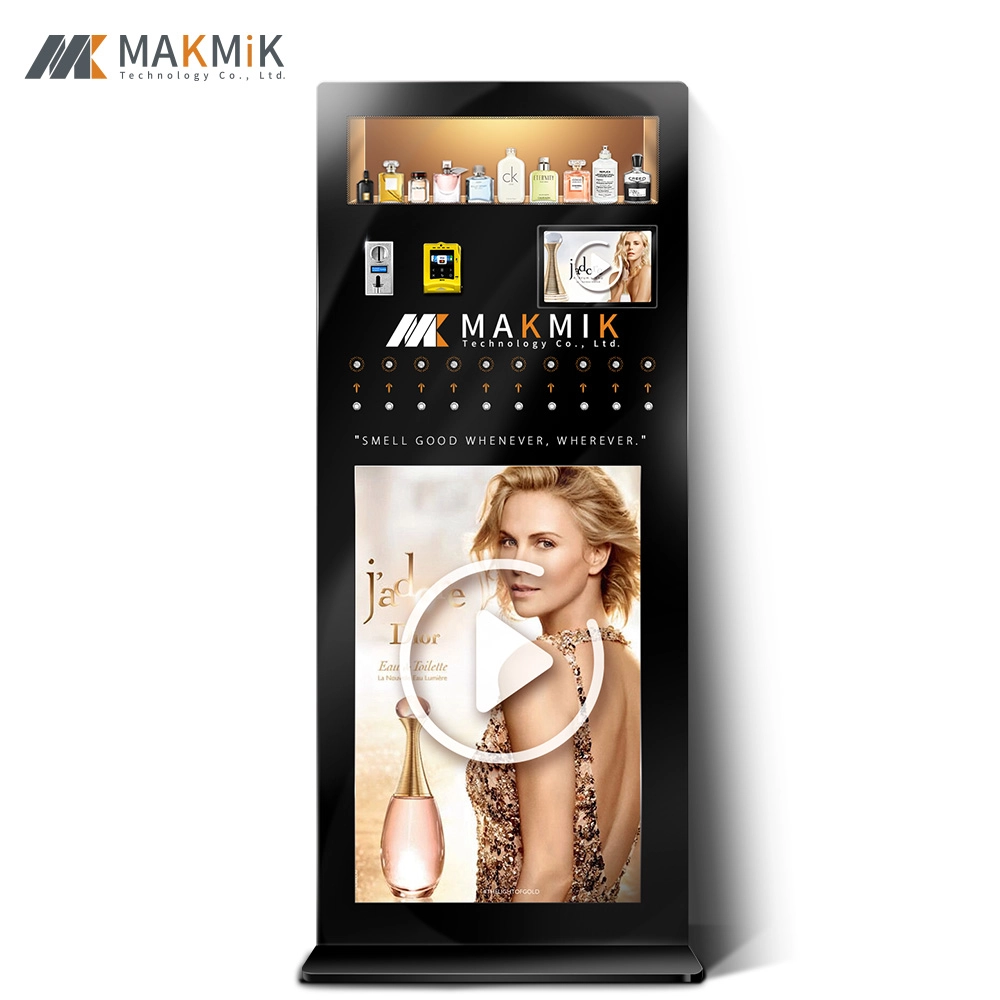
Elevate your sales with MAKMIK MK-PM-S001-1. This High Quality perfume display case perfectly tops our optimized new perfume vending machine. Showcase fragrances beautifully atop your vertical 10-nozzle perfume spray vending machine, attracting more customers and boosting engagement.

Discover the convenience of MAKMIK's small vending machines for sale. Perfect for compact spaces, these machines provide reliable service and easy maintenance, enhancing your business effortlessly. Optimize your vending operations with MAKMIK's innovative design and unmatched quality. Explore the best selection of small vending machines for sale today!
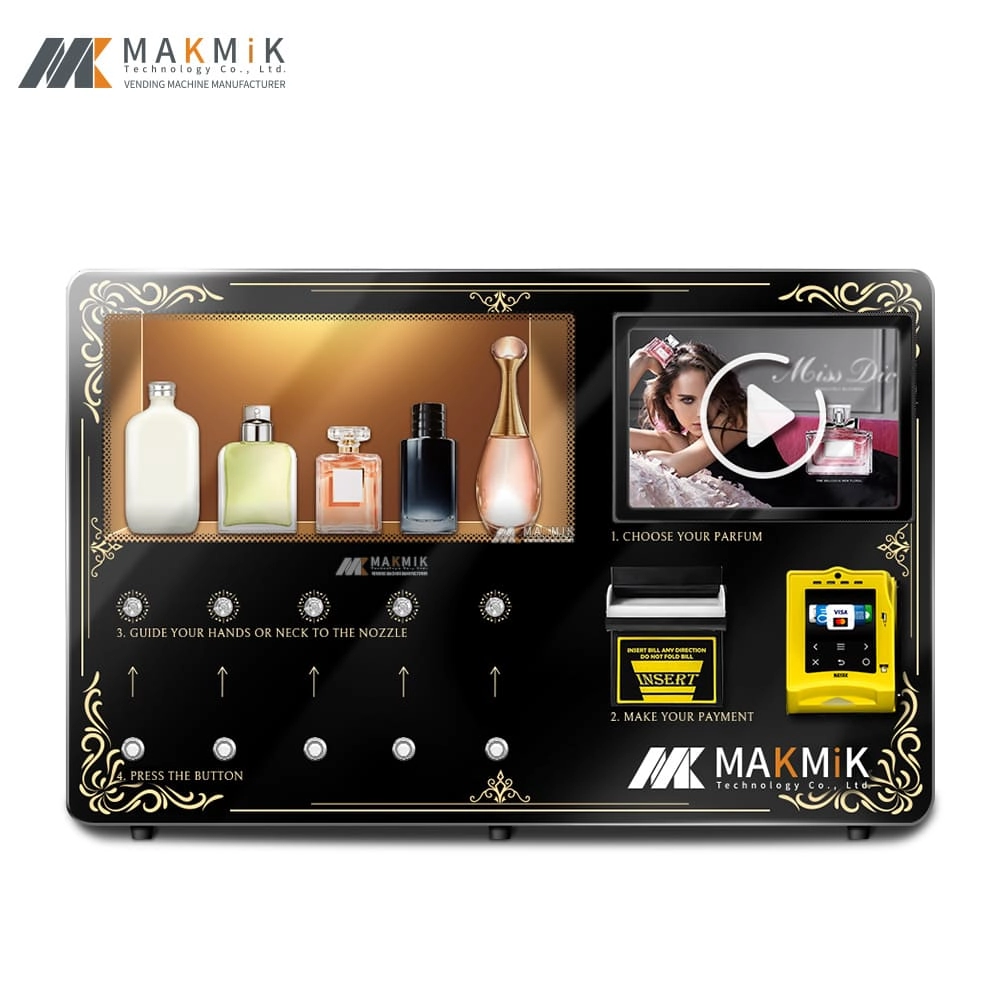
Introducing the MAKMIK Perfume Vending Machine Small Perfume Dispenser MK-PM-002—a sleek, innovative solution for instant fragrance access. Perfect for any venue, this compact perfume vending machine ensures convenience and variety. Discover MAKMIK's exceptional quality with this perfume vending machine for sale today!
Customizable appearance and functions according to actual needs, multiple ways to combine, fast customer acquisition

Introducing the MAKMIK Split Base Model MK-PM001, a cutting-edge perfume vending machine designed for modern convenience. This smart vending solution offers seamless operation and a sleek design, bringing the latest in fragrance technology to your fingertips. Elevate your space with the perfume vending machine by MAKMIK.
Customisable appearance and functions according to actual needs, multiple ways to combine, fast customer acquisition.
Social Media:
© 2026 MAKMIK | All Rights Reserved.
Facebook
Linkedlin
YouTube
Instagram