


Maintenance Checklist for High Capacity Perfume Vending

- Operational Maintenance Framework for High-Volume Fragrance Dispensers
- Core preventive checklist for field technicians
- Hygiene and aerosol safety controls
- Electrical and mechanical integrity tests
- Remote Monitoring, Predictive Servicing, and Data-Driven Uptime
- IoT telemetry and condition-based alerts
- Predictive maintenance models and ML insights
- Remote diagnostics and secure OTA updates
- Consumables Management, Spare Parts, and Service Logistics
- Consumables forecasting and SKU control
- Spare-part strategy and RMA workflow
- Service routing and SLA optimization
- Inspection Protocols, KPIs, and Procurement Checklist
- Key performance indicators for procurement and operations
- Onboarding acceptance test and factory QA
- Procurement red flags and vendor due diligence
- MAKMIK: Supplier Capabilities, Quality Controls, and Product Advantages
- Production capacity and quality assurance
- Technical team and product portfolio
- Service model, compliance, and global reach
- Implementation Roadmap and Best-Practice SOPs
- Phase 1 — Pilot and validation
- Phase 2 — Scale and operationalize
- Phase 3 — Continuous improvement and lifecycle management
- Frequently Asked Questions
- How often should fragrance cartridges and nozzles be replaced to ensure consistent atomization?
- What safety and regulatory checks are necessary for operating automated perfume dispensers in public spaces?
- Can telemetry truly reduce on-site service visits, and by how much?
- What spare parts should be stocked regionally to minimize MTTR?
- How should firmware updates and security be managed for a distributed fleet of dispensers?
- Frequently Asked Questions
For procurement teams and facility operators deploying large-scale fragrance dispensing kiosks, this structured maintenance guide delivers a concise preventive and predictive servicing checklist, operational KPIs, parts and consumables management, hygiene and aerosol safety controls, and remote-diagnostics best practices to maximize uptime, reduce TCO, and support compliance across retail and hospitality deployments; the approach integrates IoT telemetry, scheduled inspections, and standardized SOPs to support scalable rollouts of perfume dispensing systems while referencing industry guidance from vending machine (Wikipedia), ISO 9001 (quality management), and the IEEE Internet of Things initiative for device lifecycle governance.
Operational Maintenance Framework for High-Volume Fragrance Dispensers
Core preventive checklist for field technicians
Implement a standardized inspection routine that covers external cabinet integrity, electrical safety checks, dispenser nozzle condition, aerosol cartridge seating, battery or power-supply voltage, and touchscreen and payment module responsiveness. Each station should have a documented pre-shift and post-shift checklist to capture visual defects and functional failures. This reduces emergency call-outs and is aligned with quality management principles in ISO 9001.
Hygiene and aerosol safety controls
Fragrance dispensers emit aerosols and must meet local ventilation and consumer safety expectations. Maintain nozzle sterilization routines, replace or service air filters on a defined schedule, and log every cartridge change. Buyers should verify material compatibility and labeling for consumer safety; regulatory context and public health guidance can be cross-referenced via the FDA and applicable national agencies.
Electrical and mechanical integrity tests
Include multimeter verification of power rails, torque checks on fastening points, continuity tests for grounding, and load tests for motors or pumps. Document vibration or noise anomalies and escalate recurring mechanical faults to engineering for root-cause analysis. This routine prevents in-field failures and protects cosmetic products from contamination due to mechanical malfunction.
Remote Monitoring, Predictive Servicing, and Data-Driven Uptime
IoT telemetry and condition-based alerts
Leverage real-time telemetry for fluid level, nozzle cycle counts, actuator current draw, and environmental conditions (temperature/humidity). Configure alert thresholds for refill, abnormal current (indicating mechanical wear), and environmental anomalies. The IEEE IoT guidance recommends device lifecycle information management to maximize reliability: IEEE Internet of Things.
Predictive maintenance models and ML insights
Implement machine-learning models to predict component failure windows using historical telemetry and service logs. Predictive servicing reduces reactive maintenance and can lower spare-part inventory while improving first-time-fix rates. Procurement teams should evaluate vendors’ data model transparency and SLAs for model retraining cadence.
Remote diagnostics and secure OTA updates
Enable secure remote access for log retrieval, firmware updates, and configuration management. Over-the-air (OTA) update processes should include rollback capability and cryptographic signing to prevent malicious modifications. Operators must include update cycles in maintenance SOPs and verify compatibility with cosmetic product dispensing firmware.
Consumables Management, Spare Parts, and Service Logistics
Consumables forecasting and SKU control
Use sales velocity and telemetry to forecast cartridge, nozzle, and filter consumption. Consolidate SKUs across regions where possible to reduce procurement complexity; plan safety stock levels using lead time and service-level targets. Buyers should require vendors to provide lifecycle cost models for consumables and packaging.
Spare-part strategy and RMA workflow
Define critical spares (pump assemblies, PCBs, nozzles, payment modules) and maintain a min/max inventory per region. RMA workflows should include triage, bench testing, and repair versus replace decision trees. For scalable rollouts, consider vendor-managed inventory (VMI) or consignment models to shorten MTTR.
Service routing and SLA optimization
Optimize field service routes using telemetry-driven prioritization. Higher-priority alarms (safety, leaking, power fault) require same-day response, while consumable refills can be batched. Establish clear SLAs that align with retailer hours and peak traffic patterns to avoid revenue loss during busy periods.
Inspection Protocols, KPIs, and Procurement Checklist
Key performance indicators for procurement and operations
Track uptime percentage, mean time to repair (MTTR), mean time between failures (MTBF), first-time-fix rate (FTFR), refill accuracy, and customer-reported incidents per 10,000 transactions. Benchmarks for connected fragrance dispensing systems typically show improvements in uptime and reduced manual interventions when telemetry is active.
Onboarding acceptance test and factory QA
Include factory acceptance testing (FAT) and site acceptance testing (SAT) that validate dispensing volumes, spray atomization quality, electrical safety, payment integration, and network connectivity. Demand traceable component certifications and batch records as part of vendor QA documents to satisfy compliance auditors.
Procurement red flags and vendor due diligence
Require documentation for ISO certification, firmware security practices, spare-part lead times, and warranties. Verify the vendor’s production capacity, R&D depth, and field service network. Cross-reference vendor claims with third-party technical literature and standards bodies.
| Metric | Scheduled/Reactive Maintenance | IoT-Enabled Predictive Servicing | Automated Replenishment & Remote Diagnostics |
|---|---|---|---|
| Typical monthly downtime | 8–20 hours | 2–6 hours | <2 hours |
| Field labor hours per site/month | 20–60 hours | 5–15 hours | 2–5 hours |
| Refill frequency | Weekly | Bi-weekly (optimised) | Monthly (bulk or on-demand) |
| Service error/complaint rate | 5–15% | 1–5% | <1% |
| Typical ROI timeframe | 12–36 months | 6–18 months | 3–12 months |
Note: Table ranges are based on industry field reports comparing manual servicing and connected maintenance approaches; buyers should validate projections against their own transaction volumes and regional service costs. For broader device lifecycle and quality system guidelines, consult ISO 9001 and technical IoT frameworks from IEEE.
MAKMIK: Supplier Capabilities, Quality Controls, and Product Advantages
Production capacity and quality assurance
MAKMIK is a high-tech enterprise focusing on integrated software and hardware solutions for smart unattended retail. With more than 10 years of R&D and production experience in the Internet of Things and unmanned retail industries, we operate advanced production lines and maintain strict quality control. Our manufacturing footprint exceeds 20,000 square meters and supports thousands of units per year via fully automatic assembly lines, CNC machining centers, laser cutting machines, and automatic welding equipment—enabling consistent build quality and rapid scalability for fragrance dispenser programs.
Technical team and product portfolio
Our team comprises over 300 skilled technical workers across hardware, firmware, cloud services, and after-sales support. Product offerings include perfume vending machines, perfume spray vending machines, beauty vending machines, beverage vending machines, and fresh food vending machines. Buyers deploying extensive fragrance kiosk networks benefit from our integrated telemetry stack, spare-part logistics, and configurable refilling workflows.
Service model, compliance, and global reach
We provide vendor-managed inventory options, field-service training packages, and OTA firmware management with secure update signatures. MAKMIK adheres to best-practice device lifecycle management and partners with customers to customize acceptance testing and SLA frameworks. Our perfume dispensing solutions are deployed globally and designed to meet regional safety and consumer labeling requirements; facility owners are advised to map local aerosol and consumer product guidance when implementing programs.
Implementation Roadmap and Best-Practice SOPs
Phase 1 — Pilot and validation
Run a 4–8 week pilot across representative locations to validate dispensing profiles, refill cadence, payment integration, and network resilience. Use pilot telemetry to refine predictive thresholds and spare-part lists.
Phase 2 — Scale and operationalize
Scale using regional hubs for spare-part stocking, train local technicians, and implement VMI or consignment where appropriate. Ensure secure cloud provisioning for device fleet management and schedule quarterly QA audits.
Phase 3 — Continuous improvement and lifecycle management
Track KPIs and incorporate firmware and mechanical improvements into iterative production runs. Plan product end-of-life and retrofit paths for legacy units to protect long-term investments.
Frequently Asked Questions
How often should fragrance cartridges and nozzles be replaced to ensure consistent atomization?
Replace cartridges based on sales velocity and telemetry; in high-traffic locations this may be weekly to bi-weekly, while moderate-traffic sites may require changes monthly—nozzles should be inspected and replaced on a scheduled cycle (for example, every 3–6 months) or sooner if atomization quality degrades.
What safety and regulatory checks are necessary for operating automated perfume dispensers in public spaces?
Operators must ensure proper labeling and material safety data for consumer products, maintain ventilation and nozzle hygiene, and follow local regulations for aerosolized consumer goods. Consult national agencies and general guidance from organizations such as the FDA where applicable for consumer product oversight.
Can telemetry truly reduce on-site service visits, and by how much?
Yes. Connected monitoring enables condition-based servicing and remote troubleshooting, typically reducing routine site visits by 40–80% depending on baseline practices; this depends on telemetry coverage, alert configurations, and the robustness of remote diagnostic tools.
What spare parts should be stocked regionally to minimize MTTR?
Prioritize pumps or actuator assemblies, nozzle kits, payment terminal modules, primary PCBs, and power supply units. Maintain a minimal critical-spare set per region and leverage vendor-managed stocking for rapid replenishment on larger deployments.
How should firmware updates and security be managed for a distributed fleet of dispensers?
Use signed OTA updates with staged rollouts and rollback pathways. Maintain a secure update server, ensure devices validate signatures before applying updates, and log all update events for auditability. Include update windows in SLAs to minimize operational disruption.
Contact MAKMIK to view product specifications, arrange pilot deployments, or request a tailored maintenance and service-level proposal.
Frequently Asked Questions
How often should fragrance cartridges and nozzles be replaced to ensure consistent atomization?
Replace cartridges based on sales velocity and telemetry; in high-traffic locations this may be weekly to bi-weekly, while moderate-traffic sites may require changes monthly—nozzles should be inspected and replaced on a scheduled cycle (for example, every 3–6 months) or sooner if atomization quality degrades.
What safety and regulatory checks are necessary for operating automated perfume dispensers in public spaces?
Operators must ensure proper labeling and material safety data for consumer products, maintain ventilation and nozzle hygiene, and follow local regulations for aerosolized consumer goods. Consult national agencies and general guidance from organizations such as the FDA where applicable for consumer product oversight.
Can telemetry truly reduce on-site service visits, and by how much?
Yes. Connected monitoring enables condition-based servicing and remote troubleshooting, typically reducing routine site visits by 40–80% depending on baseline practices; this depends on telemetry coverage, alert configurations, and the robustness of remote diagnostic tools.
What spare parts should be stocked regionally to minimize MTTR?
Prioritize pumps or actuator assemblies, nozzle kits, payment terminal modules, primary PCBs, and power supply units. Maintain a minimal critical-spare set per region and leverage vendor-managed stocking for rapid replenishment on larger deployments.
How should firmware updates and security be managed for a distributed fleet of dispensers?
Use signed OTA updates with staged rollouts and rollback pathways. Maintain a secure update server, ensure devices validate signatures before applying updates, and log all update events for auditability. Include update windows in SLAs to minimize operational disruption.

Discover the convenience of MAKMIK's small vending machines for sale. Perfect for compact spaces, these machines provide reliable service and easy maintenance, enhancing your business effortlessly. Optimize your vending operations with MAKMIK's innovative design and unmatched quality. Explore the best selection of small vending machines for sale today!
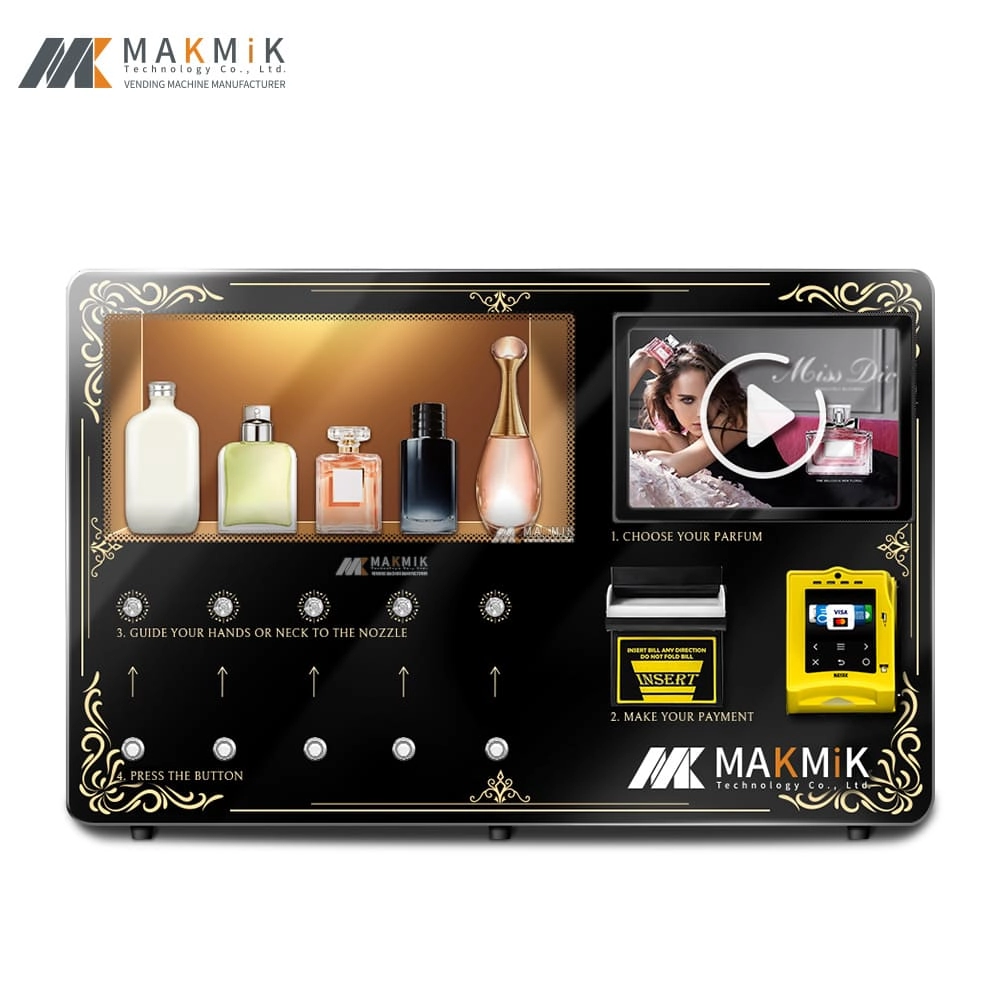
Introducing the MAKMIK Perfume Vending Machine Small Perfume Dispenser MK-PM-002—a sleek, innovative solution for instant fragrance access. Perfect for any venue, this compact perfume vending machine ensures convenience and variety. Discover MAKMIK's exceptional quality with this perfume vending machine for sale today!
Customizable appearance and functions according to actual needs, multiple ways to combine, fast customer acquisition

Introducing the MAKMIK Split Base Model MK-PM001, a cutting-edge perfume vending machine designed for modern convenience. This smart vending solution offers seamless operation and a sleek design, bringing the latest in fragrance technology to your fingertips. Elevate your space with the perfume vending machine by MAKMIK.
Customisable appearance and functions according to actual needs, multiple ways to combine, fast customer acquisition.

Discover the future of beauty retail with the Makmik Customized Innovation Smart Cosmetics Contact Lenses Sunscreen Vending Machine. Designed by MAKMIK, this cutting-edge beauty vending machine offers a seamless shopping experience, providing instant access to cosmetics and lenses. This unique cosmetics vending machine solution is designed to elevate your business.
Social Media:
© 2026 MAKMIK | All Rights Reserved.
Facebook
Linkedlin
YouTube
Instagram