


Top 10 Benefits of a Luxury Perfume Vending Kiosk for Retailers

- Operational Efficiency and Retail Uplift from High Quality Scent Dispensers
- 1. Improved Revenue Density and Upsell Opportunities
- 2. Reduced Labor and Consistent Service Delivery
- 3. Hygiene, Compliance, and Risk Mitigation
- Marketing Intelligence and Consumer Experience Advantages
- 4. Data-Driven Merchandising and Personalization
- 5. Enhanced Brand Storytelling and Sampling Control
- 6. 24/7 Availability and Omnichannel Conversions
- Procurement, Deployment, and Total Cost Insights for Enterprise Buyers
- 7. Lower Total Cost of Ownership with Scalable Manufacturing
- 8. Simplified Inventory and Replenishment Logistics
- 9. Customization, Security, and Durability for High-Traffic Environments
- Commercial Validation and Comparative Metrics
- 10. Measurable ROI and Real-World Performance Indicators
- Comparative Evaluation: Traditional Sampling vs. Automated Fragrance Stations
- Why MAKMIK Is a Strategic Partner for High Quality Fragrance Automation
- Frequently Asked Questions
High-end automated fragrance dispensers—High Quality self-service scent terminals—offer retailers a blended solution of omnichannel convenience, hygiene-conscious sampling, and data-rich merchandising that increases per-location revenue, reduces labor dependency, and enables rapid scaling; this analysis explores ten operational and commercial advantages, compares conventional in-person sampling with automated dispensers, references authoritative sources on vending and IoT technologies, and outlines procurement considerations for enterprise buyers evaluating contracted deployments.
Operational Efficiency and Retail Uplift from High Quality Scent Dispensers
1. Improved Revenue Density and Upsell Opportunities
Deploying a high-end fragrance dispensing terminal in concourse areas, department store lobbies, or luxury hotel foyers increases revenue per square meter by creating a compact retail touchpoint. Unlike floor-standing displays that require constant staffing, a self-service scent station converts foot traffic into transactions at retail density while reducing fixed headcount costs. Measurable KPIs include dwell-to-purchase ratio, attach rate for complementary SKUs, and average transaction value—metrics accessible through integrated telemetry and POS telemetry.
2. Reduced Labor and Consistent Service Delivery
Automated perfume dispensers eliminate the need for one-to-one sampling consultations during peak hours, enabling consistent product presentation without staffing variability. For procurement teams, this translates to predictable operating expenditure (OpEx) and simplified staffing models. Centralized software updates ensure promotions, pricing, and instructional content remain uniform across locations, minimizing training overhead.
3. Hygiene, Compliance, and Risk Mitigation
In markets with heightened hygiene expectations, touchless or single-use fragrance delivery mechanisms lower contamination risk compared with communal sprayers and testers. Regulatory and quality-management frameworks such as ISO 9001 support procurement policies that prefer devices with controlled dispensing and traceability. For retailers operating across jurisdictions, an enclosed dispensing system simplifies compliance with local product safety and consumer protection rules.
Marketing Intelligence and Consumer Experience Advantages
4. Data-Driven Merchandising and Personalization
Integrated sensors and IoT connectivity transform a scent station into a data capture node. Anonymous engagement metrics (sample volume, time-of-day usage, conversion rates) feed merchandising algorithms that optimize assortments and promotional timing. IEEE research on IoT architectures highlights the benefits of edge processing for low-latency analytics in retail deployments (IEEE IoT overview).
5. Enhanced Brand Storytelling and Sampling Control
High Quality fragrance terminals enable curated brand narratives—dynamic displays, sample sequencing, and limited-edition drops—while maintaining strict portion control. This reduces product loss from over-spraying and preserves luxury perception by delivering precise, repeatable sample experiences that align with brand positioning.
6. 24/7 Availability and Omnichannel Conversions
Automated scent stations enable frictionless customer journeys beyond store hours, supporting click-and-collect or in-situ QR-code product pages that drive e-commerce fulfillment. Continuous availability expands touchpoint coverage for international travelers and late-hour shoppers, increasing the addressable audience and supporting omnichannel attribution models.
Procurement, Deployment, and Total Cost Insights for Enterprise Buyers
7. Lower Total Cost of Ownership with Scalable Manufacturing
Capital procurement should account for lifecycle costs: acquisition, maintenance, consumables, software licensing, and network connectivity. Sourcing from manufacturers with integrated production capabilities reduces lead time and improves spare-parts availability—key for multinational rollouts. Industry data on automated retail channels shows growing adoption of smart vending hardware globally (Statista vending machine market).
8. Simplified Inventory and Replenishment Logistics
Modular dispenser designs and telemetry-driven inventory reports allow centralized replenishment scheduling. For category managers, this reduces stockouts and improves fill rates while optimizing route density for service teams. Enterprise-grade APIs enable integration with existing ERP and warehouse-management systems to automate procurement triggers.
9. Customization, Security, and Durability for High-Traffic Environments
Vendors offering configurable cabinetry, secure locking mechanisms, and industrial-grade components ensure long-term uptime. Buyers should request MTBF (mean time between failures), warranty terms, and on-site service SLAs to evaluate resilience in high-traffic retail corridors. Technical due diligence should verify compliance with local electrical and safety standards and request test reports or certifications.
Commercial Validation and Comparative Metrics
10. Measurable ROI and Real-World Performance Indicators
ROI typically derives from incremental sales, labor savings, and reduced shrinkage. Pilot programs should define success criteria—sales uplift percentage, payback period, and customer engagement rates—and run for statistically significant windows. Retail analytics combined with telemetry provide the transparency needed to refine rollouts and validate vendor claims.
Comparative Evaluation: Traditional Sampling vs. Automated Fragrance Stations
The table below summarizes key feature-level differences between conventional in-person perfume sampling and automated scent dispensing terminals for enterprise consideration.
| Feature | In-Person Sampling | Automated Fragrance Terminal |
|---|---|---|
| Availability | Limited to store hours and staff presence | 24/7 operation with remote monitoring |
| Labor Requirement | High — trained consultants required | Low — reduced staffing, automated interactions |
| Hygiene & Safety | Shared testers, higher contamination risk | Controlled single-dose dispensing, lower contamination |
| Data & Analytics | Manual tracking, limited sampling | Real-time telemetry, conversion analytics |
| Scalability | Labor and training constraints | Rapid multi-location deployments with remote management |
| Inventory Control | Manual counts, higher shrinkage | Telemetry-based replenishment, lower loss |
For enterprises, the decision matrix should weight these factors relative to traffic patterns, brand positioning, and long-term retail strategy. Evidence from vending and automated retail studies supports a shift toward unmanned solutions in high-traffic and hygiene-sensitive contexts (Vending machine overview).
Why MAKMIK Is a Strategic Partner for High Quality Fragrance Automation
MAKMIK is positioned as a high-tech enterprise focused on integrated software and hardware solutions for smart vending in the new retail field, with more than ten years of R&D and production experience in the Internet of Things and unmanned retail sectors. For enterprise buyers, MAKMIK presents procurement advantages grounded in manufacturing scale, engineering depth, and quality assurance processes.
Our manufacturing footprint includes more than 20,000 square meters of production capacity, fully automatic assembly lines, CNC machining centers, laser cutting systems, and automated welding equipment. With over 300 skilled technical workers, the supply chain is capable of producing thousands of vending units per year while adhering to strict quality control standards—attributes that reduce lead times and improve spare-parts responsiveness for multi-location rollouts.
Product offerings span modular scent dispensers and end-to-end vending solutions, including perfume vending machines and fragrance spray dispensers. Software stacks support remote device management, telemetry dashboards, and API integrations for ERP and e-commerce channels. These capabilities enable enterprise retailers to deploy branded sampling programs, limited-edition launches, and data-driven promotions across shopping centers, airports, and hospitality venues.
Procurement teams evaluating partners should note MAKMIK’s emphasis on lifecycle support: from concept and industrial design to production, certification, and global after-sales service. This vertical integration minimizes third-party dependencies, aligns manufacturing QA with vendor SLAs, and supports compliance workflows across regions.
For buyers prioritizing hygiene-conscious, scalable, and data-enabled fragrance sampling solutions, MAKMIK’s portfolio—including perfume vending machine and perfume spray vending machine variants—offers configurable platforms optimized for luxury retail environments and unmanned operations. For technical due diligence, MAKMIK can provide test reports, firmware update policies, and MTBF projections to support enterprise procurement decisions.
Relevant industry frameworks and research support the move toward smart, connected retail hardware; buyers may consult standards and technology resources such as ISO 9001, IoT architectural guidance from IEEE, and market trend data from Statista when building procurement specifications.
To discuss pilot scopes, customization options, and enterprise pricing tiers, procurement and category managers are encouraged to request a formal proposal that includes expected KPIs, deployment timelines, and service-level commitments.
Contact MAKMIK to request technical datasheets, certification records, and a tailored ROI model for multi-site fragrance dispenser rollouts.
Frequently Asked Questions
What are the primary business benefits of deploying a premium automated fragrance dispenser?
Primary benefits include increased revenue density, reduced labor costs, improved hygiene through controlled dispensing, 24/7 availability, and access to telemetry-driven merchandising data for better inventory and promotional decisions.
How does an automated scent station improve hygiene and compliance compared with traditional testers?
Automated systems provide controlled single-dose or enclosed dispensing that minimizes shared-contact surfaces, reduces contamination risk, and simplifies compliance with product safety and quality-management frameworks such as ISO 9001.
What procurement considerations should enterprise buyers evaluate when selecting a vendor?
Buyers should review manufacturing capacity, MTBF and warranty terms, software update policies, API availability for ERP integration, local certification compliance, spare-parts logistics, and on-site service SLAs for multi-location deployments.
Can telemetry from fragrance dispensers integrate with existing retail analytics and ERP systems?
Yes. Enterprise-grade scent stations typically provide APIs and data export capabilities that allow anonymized engagement metrics, inventory levels, and transaction records to be integrated into ERP, WMS, and retail-analytics platforms for centralized reporting.
What ROI metrics should be defined for pilot projects of automated perfume dispensers?
Define KPIs such as sales uplift percentage, payback period, conversion rate from sample-to-purchase, reduction in staffing hours, and refill intervals; pilots should run for a statistically significant period to validate performance against these targets.

Discover the convenience of MAKMIK's small vending machines for sale. Perfect for compact spaces, these machines provide reliable service and easy maintenance, enhancing your business effortlessly. Optimize your vending operations with MAKMIK's innovative design and unmatched quality. Explore the best selection of small vending machines for sale today!
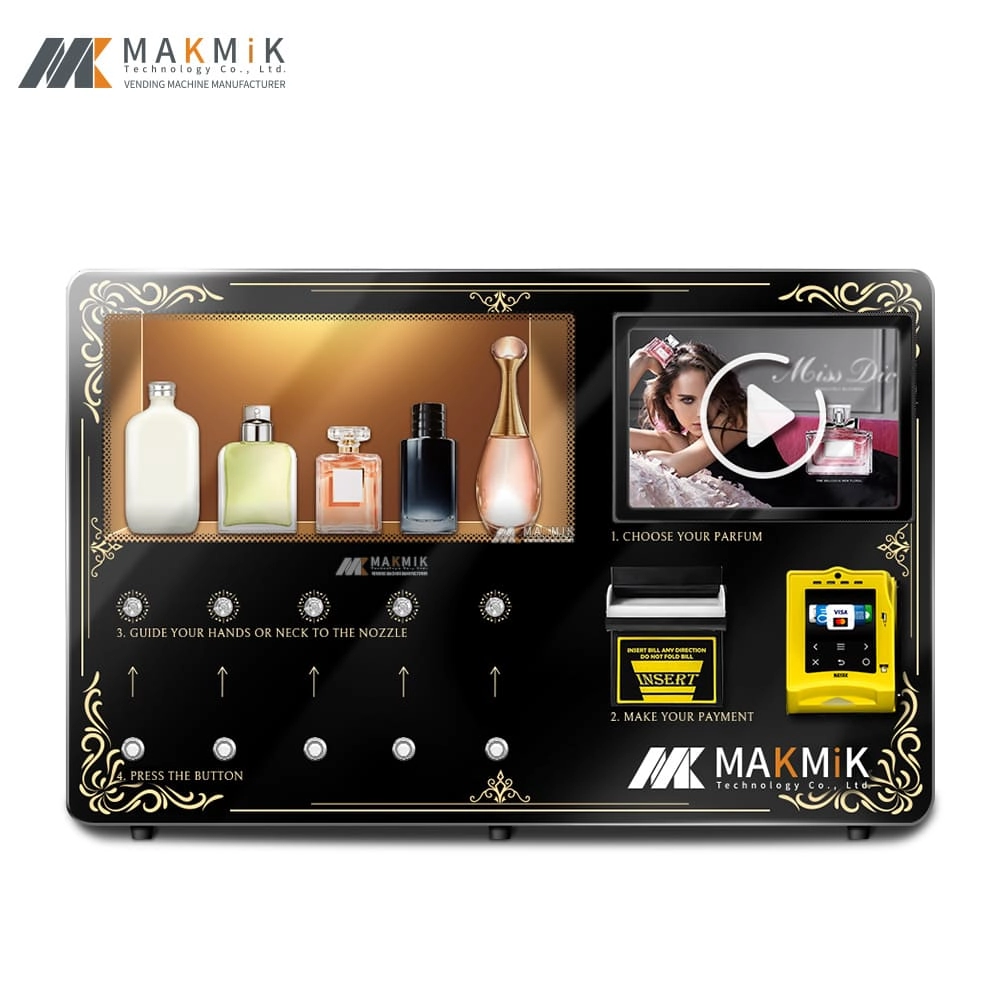
Introducing the MAKMIK Perfume Vending Machine Small Perfume Dispenser MK-PM-002—a sleek, innovative solution for instant fragrance access. Perfect for any venue, this compact perfume vending machine ensures convenience and variety. Discover MAKMIK's exceptional quality with this perfume vending machine for sale today!
Customizable appearance and functions according to actual needs, multiple ways to combine, fast customer acquisition

Introducing the MAKMIK Split Base Model MK-PM001, a cutting-edge perfume vending machine designed for modern convenience. This smart vending solution offers seamless operation and a sleek design, bringing the latest in fragrance technology to your fingertips. Elevate your space with the perfume vending machine by MAKMIK.
Customisable appearance and functions according to actual needs, multiple ways to combine, fast customer acquisition.

Discover the future of beauty retail with the Makmik Customized Innovation Smart Cosmetics Contact Lenses Sunscreen Vending Machine. Designed by MAKMIK, this cutting-edge beauty vending machine offers a seamless shopping experience, providing instant access to cosmetics and lenses. This unique cosmetics vending machine solution is designed to elevate your business.
Social Media:
© 2026 MAKMIK | All Rights Reserved.
Facebook
Linkedlin
YouTube
Instagram