


Data Collection Methods in a Sample Vending Machine: QR Codes, Surveys, Sensors & Facial Recognition
- Quick Answer
- Comparing Data Collection Methods
- 1. QR Codes: Connecting the Machine to a Mobile Interaction
- 2. Touchscreen Surveys and Zero-Party Data
- 3. Dispense Logs: Valuable Data Without Personal Identification
- 4. IoT Telemetry and Remote Machine Data
- 5. Traffic Sensors, Interaction Rate, and Dwell Time
- 6. Facial Recognition and Camera-Based Analytics Are Not the Same Thing
- 7. Turning Machine Data Into Useful Decisions
- Product Interest
- Location Performance
- Campaign Funnel
- Operational Performance
- 8. Data Minimization Matters More Than Data Volume
- 9. Privacy and Consent Should Be Designed Into the Workflow
- Choosing the Right Data Collection Method
- Frequently Asked Questions
- What data can a sample vending machine collect?
- Does a QR code automatically collect personal data?
- What is zero-party data in automated sampling?
- Can sample vending machines track campaign performance without collecting personal information?
- Does MAKMIK provide facial recognition as a standard feature?
- How should brands choose which data to collect?
- Build the Data Flow Around the Campaign Goal
Quick Answer
QR codes and touchscreen forms are usually the most direct ways to collect consent-based customer information such as contact details and product preferences. Dispense records and IoT telemetry are better suited to operational data such as sample volume, time of interaction, inventory status, and machine performance. Traffic sensors or camera-based analytics can support broader audience measurement, but personally identifiable or biometric data introduces significantly greater privacy and compliance requirements. If a campaign does not need to identify an individual, collecting less sensitive data is generally the simpler approach.
A sample vending machine can collect useful campaign data without turning every interaction into a lengthy registration process. The most practical methods include QR codes, touchscreen surveys, dispense logs, IoT telemetry, traffic sensors, and—where legally and technically appropriate—camera-based analytics.
The right method depends on what the campaign actually needs to measure. A brand trying to build an opt-in contact list has very different data requirements from an operator measuring sample consumption, machine uptime, foot traffic, or conversion by location. At MAKMIK, we recommend defining the required data points before deciding which hardware, interface, sensors, or software integrations are necessary.
Comparing Data Collection Methods
| Method | Typical Data | Best Fit | Main Consideration |
|---|---|---|---|
| QR code | Form submissions, campaign source, opt-in details | Lead generation and mobile engagement | Requires a clear mobile flow and consent |
| Touchscreen survey | Preferences, product interests, feedback | Zero-party data collection | Keep questions short enough to avoid abandonment |
| Dispense logs | Product, time, quantity, machine location | Campaign measurement and inventory analysis | Usually does not require personal identity |
| IoT telemetry | Machine status, inventory, faults, connectivity | Operations and remote management | Requires reliable connectivity and system integration |
| Traffic or proximity sensors | Footfall, interaction count, dwell time | Location and engagement analysis | Define how anonymous data will be processed |
| Camera-based analytics | Depending on configuration, audience or identity-related data | Specialized projects | Higher privacy, legal, security, and consent requirements |
1. QR Codes: Connecting the Machine to a Mobile Interaction
QR codes are one of the simplest ways to connect a physical sample vending machine with a digital campaign. A QR code can open a landing page, product questionnaire, registration form, promotional page, membership flow, or other mobile experience. The machine itself does not need to collect every piece of information directly.
For example, a campaign could ask a user to scan a QR code, select a product preference, provide an email address if they choose to opt in, and then receive authorization to dispense a sample.
The important distinction is that scanning a QR code does not automatically create a verified customer profile. The quality of the collected data depends on what the user is asked to provide, how consent is handled, and how the information is validated. QR-based collection can be especially useful when the campaign already has a CRM, membership system, mobile website, or marketing automation workflow.
2. Touchscreen Surveys and Zero-Party Data
A touchscreen can capture information directly at the machine before or after a sample is dispensed. Useful questions are usually short and closely connected to the product being sampled, such as fragrance preference, product category interest, or prior product experience.
The goal is not to turn the vending machine into a long questionnaire. Every additional step creates friction, so the data request should have a clear purpose. When customers intentionally provide information about their preferences, the campaign is collecting what is commonly described as zero-party data.
That data can be useful because it reflects information the customer chose to provide rather than behavior inferred indirectly from unrelated browsing activity. For campaign planning, the more useful question is not “How much data can the machine collect?” but “Which two or three data points will actually change the next marketing or operational decision?”
3. Dispense Logs: Valuable Data Without Personal Identification
A sample vending machine can generate useful information even when no customer registration is required. Basic dispense records may include variables such as:
| Data Point | What It Can Help Measure |
|---|---|
| Dispense time | Peak interaction periods |
| Product or sample selected | Relative product interest |
| Machine location | Performance by site |
| Number of samples dispensed | Campaign volume |
| Remaining inventory | Replenishment requirements |
| Failed dispense events | Operational reliability |
This is often one of the most useful forms of data because it directly connects to machine operation and campaign performance. A brand may discover, for example, that one location distributes significantly more samples during evening hours while another performs better at lunchtime. That information can influence replenishment schedules, campaign timing, and future machine placement without requiring the identity of every person using the machine.
When several machines are deployed, structured dispense data also makes it easier to compare locations rather than relying only on total sample volume.
4. IoT Telemetry and Remote Machine Data
Customer information is only one part of the data generated by smart vending equipment. IoT-connected machines can also produce operational information such as inventory status, machine connectivity, dispense events, alerts, or equipment status, depending on the selected system configuration.
For operators managing multiple units, this type of machine data can be more valuable than collecting additional personal information. A sampling campaign loses value if a popular machine is empty for several hours, a dispensing mechanism is not functioning correctly, or the operator does not know which location needs attention.
That is why data architecture should consider both marketing data and equipment data. The wider use of automated product sampling increasingly connects the physical dispensing process with inventory, campaign, and operational systems rather than treating the machine as a standalone device.
5. Traffic Sensors, Interaction Rate, and Dwell Time
Dispense volume tells you how many samples were released, but it does not necessarily tell you how effectively the machine attracted attention. For some campaigns, operators may also want to understand how many people passed the installation area, how many approached the machine, how many started an interaction, how many completed the sampling process, and how long a typical interaction took.
Depending on the deployment, proximity sensors, counters, or other traffic-measurement technologies may help estimate parts of this funnel.
Passersby → machine interactions → completed sample dispenses → downstream conversions
This helps separate a location problem from an interface problem. A machine may have high foot traffic but few interactions, suggesting that visibility or messaging needs attention. Another location may generate many interactions but few completed dispenses, which could indicate excessive steps in the user flow.
These metrics become more useful when combined with broader sampling campaign performance rather than looking only at the number of products distributed.
6. Facial Recognition and Camera-Based Analytics Are Not the Same Thing
“Facial recognition” is often used too broadly when discussing smart kiosks. There is an important difference between identifying a person and measuring anonymous audience activity.
Facial recognition generally refers to technology designed to identify or match an individual using facial characteristics. That can involve biometric information and creates substantially greater privacy, security, consent, and regulatory considerations. Camera-based audience analytics may instead be configured for functions such as people counting or other non-identifying measurements, depending on the system design. These technologies should not be treated as interchangeable.
For most sampling campaigns, the first question should be whether individual identification is necessary at all. If the objective is simply to measure interactions, sample demand, location performance, or product preference, QR forms, surveys, dispense logs, and anonymous operational analytics may provide enough information with a simpler data architecture.
Any project involving biometric identification or sensitive personal information should be evaluated according to the laws, consent requirements, security controls, and data-retention rules applicable to the deployment market. MAKMIK should therefore confirm a project's specific hardware and software requirements before any camera-based or identity-related function is included in a machine specification.
7. Turning Machine Data Into Useful Decisions
Collecting data only creates value if the information answers a business question. For sample vending deployments, useful analysis often falls into four areas.
Product Interest
Dispense volume by sample or product can show which options attract more interactions. This does not automatically prove purchase intent, but it can help brands compare demand patterns across products, time periods, and locations.
Location Performance
Comparing machines across malls, events, hotels, retail stores, transit locations, or other environments can reveal major differences in engagement. The important metric may not always be total traffic. A lower-traffic location with a higher interaction rate can sometimes provide more useful sampling performance than a high-traffic site where most people walk past the machine.
Campaign Funnel
QR scans, survey completions, sample dispenses, coupon activations, and downstream transactions can be treated as separate funnel stages when the required systems are connected. This provides more information than reporting only how many samples were distributed.
Operational Performance
Inventory levels, refill requirements, failed dispenses, connectivity, and service events help operators understand the cost and reliability of running the campaign. Once these data points are structured, teams can perform more useful consumer behavior data analysis instead of collecting information without a clear decision framework.
8. Data Minimization Matters More Than Data Volume
A common mistake in smart retail projects is collecting information simply because the technology makes collection possible. More data is not automatically better data.
If a sampling campaign only needs to determine which fragrance is most popular at a particular location, recording sample selection, timestamp, and machine location may be enough. If the objective is to build a permission-based customer list, an email address and clearly defined consent may be necessary. If the objective is inventory management, personal information may not be necessary at all.
Defining these requirements early reduces unnecessary system complexity and can simplify storage, integration, security, and compliance planning.
9. Privacy and Consent Should Be Designed Into the Workflow
Privacy should not be added after the machine interface has already been designed. Before deployment, determine what information will be collected, why each data point is necessary, whether the information is anonymous, personal, or potentially biometric, where it will be stored, which system will receive it, who will have access, how long it needs to be retained, and what consent or notice is required in the destination market.
Projects involving customer profiles, mobile numbers, emails, payment information, images, or other sensitive data need a different architecture from a machine that only records anonymous dispense events. The same principle applies to customer data privacy: collection, transmission, access, storage, and retention should be considered as one system rather than separate features.
Choosing the Right Data Collection Method
The best configuration depends on the campaign goal.
| Campaign Goal | Practical Starting Point |
|---|---|
| Count sample distribution | Dispense logs |
| Compare product popularity | Product-level dispense data |
| Build an opt-in lead list | QR form or touchscreen registration |
| Capture product preferences | Short touchscreen survey |
| Monitor machine availability | IoT telemetry |
| Compare site performance | Location + dispense + traffic data |
| Measure engagement funnel | Traffic, interaction and dispense events |
| Connect sampling to CRM | Consent-based form plus integration |
| Identify individuals | Only when genuinely necessary and after privacy/legal review |
For many deployments, combining two or three low-friction methods is more practical than trying to collect every possible data point from one interaction. A QR code can handle optional registration, the machine can record the dispense event, and IoT telemetry can monitor inventory and equipment status. Together, those systems may provide enough information to evaluate a campaign without introducing unnecessary biometric or identity-related processing.
Frequently Asked Questions
What data can a sample vending machine collect?
Depending on its configuration, a sample vending machine may record dispense events, product selections, timestamps, location data, inventory information, machine status, survey responses, QR-based form submissions, and other information generated through connected systems. The exact data set should be defined for each project rather than assumed to be standard across every machine.
Does a QR code automatically collect personal data?
No. A QR code normally directs the user to a digital destination. Personal data is collected only if the connected workflow requests and records that information. The landing page, form, consent process, and backend system determine what is actually collected.
What is zero-party data in automated sampling?
Zero-party data is information a customer intentionally provides, such as a product preference, category interest, or other response entered into a survey or registration flow.
Can sample vending machines track campaign performance without collecting personal information?
Yes. Dispense volume, sample selection, timestamp, machine location, inventory changes, equipment status, and some forms of anonymous traffic measurement can provide useful campaign information without identifying individual customers.
Does MAKMIK provide facial recognition as a standard feature?
Facial recognition should not be assumed to be a standard feature. Camera-based, identity-related, biometric, software, and data-processing requirements need to be evaluated for the specific project before configuration is confirmed.
How should brands choose which data to collect?
Start with the decision the data needs to support. If the goal is inventory management, collect operational data. If the goal is product research, collect product preference information. If the goal is opt-in lead generation, design a clear consent-based registration process. Collecting information without a defined use usually adds complexity without improving the campaign.
Build the Data Flow Around the Campaign Goal
A sample vending machine can connect physical product trial with measurable digital and operational data, but successful data collection does not depend on gathering the maximum amount of information.
The stronger approach is to define the campaign objective first, select the minimum useful data set, and then determine the hardware, interface, connectivity, and software integration required to support it. For a MAKMIK project, requirements such as QR workflows, touchscreen interaction, machine telemetry, third-party system integration, and any camera-related functions should be defined during configuration so that the final system matches the actual sampling workflow rather than adding unnecessary complexity.
Are You Exploring Automated On-Site Fragrance Sampling or Trial-Size Dispensing?
How to Compare Perfume Vending Machine Quotations Before You Buy
Perfume Vending Machine RFQ Checklist: What to Send Before Asking for a Quote
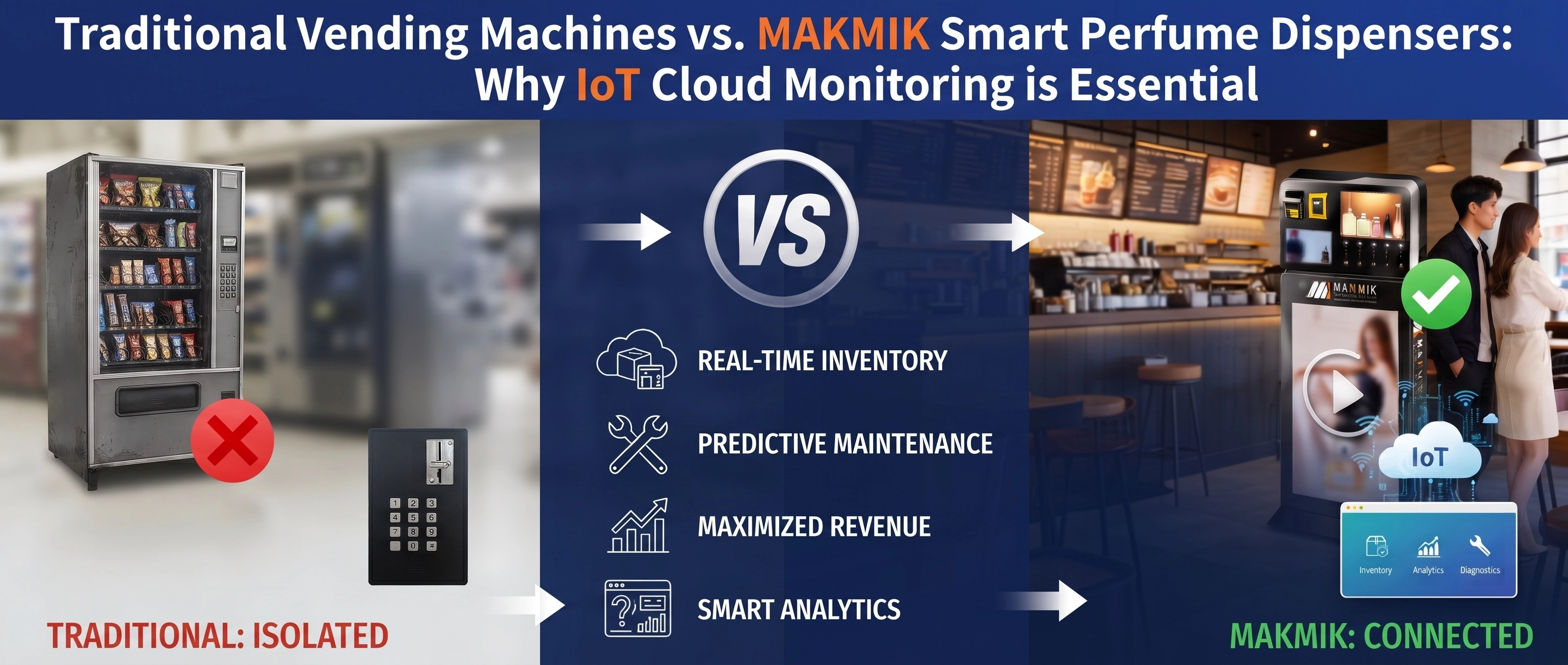
Traditional vs. MAKMIK Smart Perfume Dispensers: Why IoT Monitoring Matters
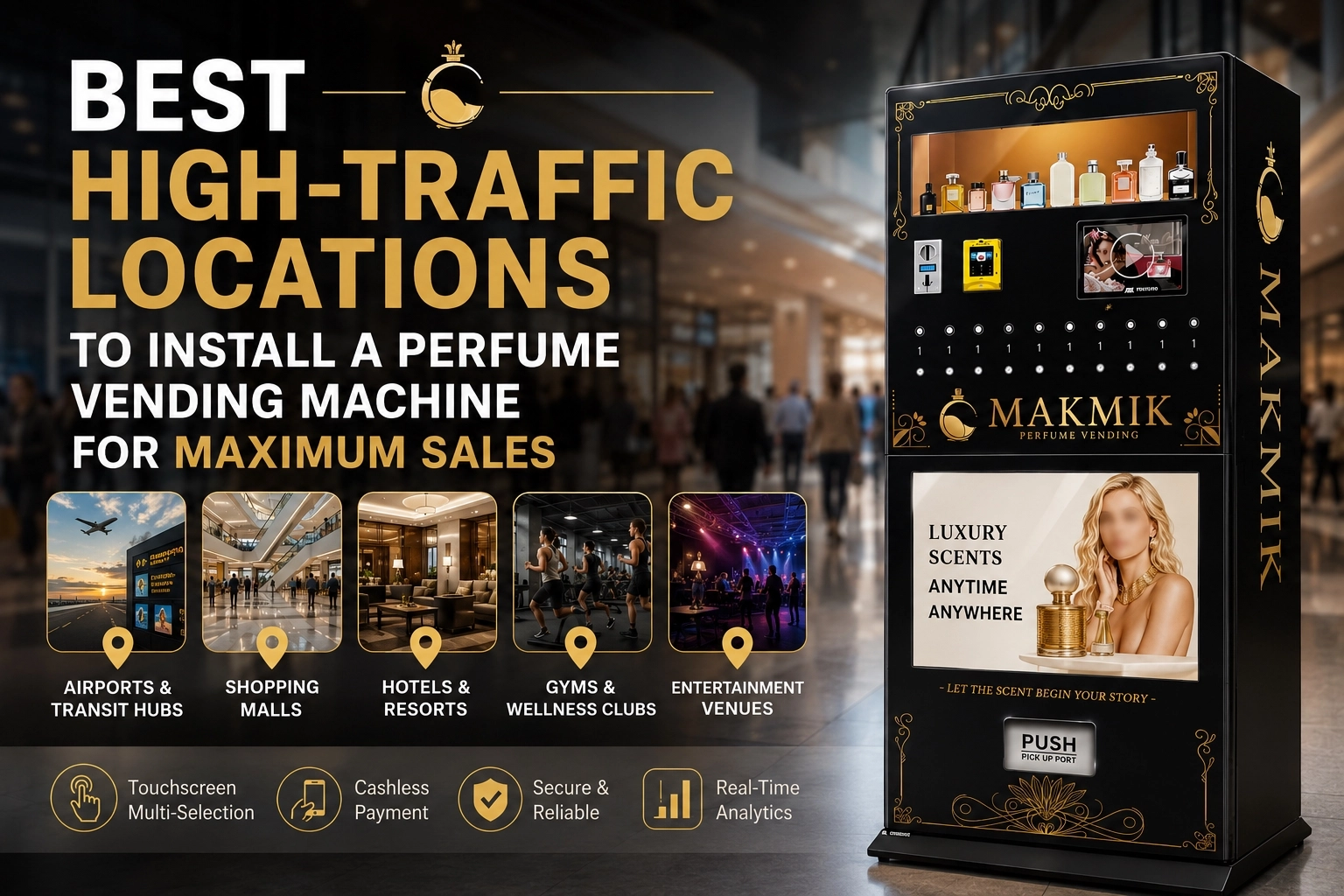
Best High-Traffic Locations to Install a Perfume Vending Machine for Maximum Sales
FAQ
How do you ensure the quality of your vending machines?
We adhere to strict quality control processes and use high-quality materials and components to ensure durability and reliability.
What types of vending machines do you manufacture?
We manufacture a wide range of vending machines, including snack, beverage, combo, fresh food, and specialty vending machines.
What is the lead time for manufacturing and delivery?
Lead times vary based on the type and quantity of vending machines ordered, but we strive to deliver within 6-8 weeks from the date of order confirmation.
Can your vending machines be customized?
Yes, we offer customization options to meet specific client requirements, including branding, product selection, and payment systems.
Distributor
Do you provide installation and maintenance services?
We provide the high-quality machines, necessary spare parts, and comprehensive remote technical support. Local installation and physical maintenance are typically handled by our distributors.


Send my request
Connect with us to schedule a consultation, request samples, or arrange a site visit to see our facilities and capabilities firsthand.
Reach out to us via phone, email, or through the contact form below, and we'll get back to you promptly within 24 hours.
Social Media:
© 2026 MAKMIK | All Rights Reserved.
Facebook
Linkedlin
YouTube
Instagram