






How to Test Perfume Spray Dispensing Accuracy in Vending Machines
- 1. What Does Perfume Spray Dispensing Accuracy Mean?
- 2. What Equipment Is Needed for a Dispensing Test?
- 3. Step-by-Step Perfume Spray Dispensing Accuracy Test
- 4. How to Calculate Dose Accuracy and Repeatability
- Illustrative Calculation
- 5. Example Test Record and Acceptance Decision
- 6. Factors That Change Dispensing Performance
- Fragrance Formulation and Temperature
- Reservoir Level and Air in the Line
- Pump, Valve, Tubing, and Nozzle Condition
- 7. Multi-Channel Testing and Cross-Contamination
- 8. How Accuracy Testing Fits Factory Acceptance
- 9. When Should Dispensing Accuracy Be Retested?
- Conclusion
- Verify Your Perfume Vending Configuration with MAKMIK
- Perfume Spray Dispensing Accuracy FAQ
Consistent perfume spray dispensing is essential when a vending machine sells fragrance by application rather than by bottle. Each paid transaction should deliver the intended amount within an agreed range. Variations can affect customer experience, fragrance consumption, refill forecasts, and operating costs.
At MAKMIK, we recommend defining a measurable target dose, a repeatable test procedure, and acceptance criteria before equipment approval. A visually attractive spray does not establish accurate dosing, and one successful cycle does not demonstrate repeatability.
Configure → Prime → Collect → Weigh → Repeat → Calculate → Compare with agreed limits. Record the fragrance, channel, liquid level, temperature, settings, and any anomalies for each test series.
1. What Does Perfume Spray Dispensing Accuracy Mean?
Dispensing accuracy describes how closely the measured output matches the specified target dose. Repeatability describes how closely consecutive measurements agree when the same channel is tested under similar conditions. These are related but different performance characteristics.
A channel may have an average close to its target but show wide cycle-to-cycle variation. Conversely, a channel may dispense almost the same amount every time while consistently exceeding the target. Both situations need to be visible in the test results.
2. What Equipment Is Needed for a Dispensing Test?
A practical gravimetric test uses mass measurements to quantify collected fragrance. The measurement setup must be suitable for the expected small dose and the volatility of the liquid.
- Calibrated balance with resolution and uncertainty appropriate to the target dose
- Compatible, clean collection vessel or closed collection arrangement
- Stable bench, suitable ventilation, and a controlled collection position
- Representative fragrance formulations and documented machine settings
- Test record for channel, cycle, mass, temperature, liquid level, and observations
Because many perfume formulations contain volatile solvents, open collection and delayed weighing can introduce evaporation losses. Use a compatible vessel and minimize the time between collection and weighing. If the spray cannot be captured quantitatively, the method may underestimate delivered mass; a validated collection fixture or alternative test method is required.
A mass result should not be converted into milliliters without an appropriate density value for the tested formulation and temperature. When the commercial specification is in volume, document the density assumption and its source.
3. Step-by-Step Perfume Spray Dispensing Accuracy Test
The number of cycles should be established in the test plan. A sample of ten measurements can illustrate calculations, but it is not a universal acceptance standard. Higher confidence requirements may call for additional repetitions, separate operating conditions, or a statistically justified sample size.
4. How to Calculate Dose Accuracy and Repeatability
For measurements expressed in the same unit, the following calculations provide a useful starting point. Define the target dose as T, each measured dose as x, and the number of measurements as n.
Mean = (sum of measured doses) ÷ n
Relative mean errorError (%) = [(Mean − T) ÷ T] × 100
Coefficient of variation (CV)CV (%) = (Sample standard deviation ÷ Mean) × 100
Mean error indicates systematic over- or under-dispensing. CV expresses cycle-to-cycle variation relative to the average. Both are useful, but they do not replace an individual-dose limit if the project requires every transaction to fall within a specified range.
Illustrative Calculation
Suppose the agreed nominal mass is 100 mg and five recorded measurements are 98, 101, 100, 99, and 102 mg. Their mean is 100 mg, the relative mean error is 0%, and the sample standard deviation is approximately 1.58 mg. The resulting CV is approximately 1.58%.
These figures are illustrative, not MAKMIK equipment performance data or a recommended acceptance tolerance. The actual pass/fail limits must be defined for the intended machine, fragrance, measurement method, and application.
5. Example Test Record and Acceptance Decision
| Channel | Test Liquid | Target | Mean | Mean Error | CV | Disposition |
|---|---|---|---|---|---|---|
| Channel A | Fragrance 1 | 100 mg | 100 mg | 0% | 1.58% | Compare with specification |
| Channel B | Fragrance 2 | 100 mg | 96 mg | −4% | 2.40% | Compare with specification |
| Channel C | Fragrance 3 | 100 mg | 103 mg | +3% | 1.90% | Compare with specification |
The sample data above are fictional and do not represent an acceptance result. The test plan should state the permitted mean deviation, permitted variability, any individual-dose limits, and how to handle invalid or interrupted cycles. A channel passes only when every applicable agreed criterion is met.
Document the balance identification, measurement method, formulation, date, operator, channel mapping, sample count, and any corrective action. These records make factory acceptance and later service investigations more reproducible.
6. Factors That Change Dispensing Performance
Fragrance Formulation and Temperature
Viscosity, volatility, density, and solvent composition may affect flow and collection. A test with one liquid cannot establish equivalent behavior for all formulations. Representative fragrances should be evaluated at relevant operating temperatures, with compatible wetted materials confirmed.
Reservoir Level and Air in the Line
Reservoir level, tubing routing, priming condition, and entrained air can affect delivery. Compare output at the expected operating liquid levels and after the refill process. Define whether initial priming cycles are excluded from paid dispensing.
Pump, Valve, Tubing, and Nozzle Condition
Wear, residue, partial blockage, loose connections, and leakage can alter dose or spray pattern. Inspect fragrance-contact parts and follow material-compatible maintenance procedures. A consistent collected mass does not guarantee an acceptable mist pattern or outlet direction.
7. Multi-Channel Testing and Cross-Contamination
In a multi-nozzle perfume vending machine, each fragrance channel requires independent verification. Confirm that the selected screen option corresponds to the intended physical outlet and that each channel delivers within its own agreed specification.
If formulations differ, channel-to-channel mass measurements may not be directly comparable without accounting for density and the specified target. Distinguish dose accuracy from scent carryover: a channel can deliver the right amount while still showing contamination from another fragrance.
Separate channel testing from multi-nozzle fragrance cross-contamination controls, which address residual scent, refill mix-ups, and channel isolation. Both require defined inspection and maintenance procedures.
8. How Accuracy Testing Fits Factory Acceptance
Factory Acceptance Testing (FAT) should verify the configured machine before shipment. For fragrance dispensing, buyers should agree on the test fluid, target dose, measurement method, repetitions, channel coverage, environmental conditions, and pass/fail limits before testing starts.
- Correct interface-to-nozzle channel mapping
- Recorded target dose and machine settings
- Mean output and repeatability within agreed limits
- No abnormal leakage, blockage, or unintended dispensing
- Documented behavior after refill, restart, or interruption
- Test results and corrective actions approved before shipment
These checks should align with the wider perfume vending machine factory acceptance criteria, including payment, interface, connectivity, cabinet, and service requirements. Buyers can specify the intended test scope in their perfume vending machine RFQ requirements before quotations are finalized.
9. When Should Dispensing Accuracy Be Retested?
Factory results provide a baseline, not a permanent guarantee. Retesting is appropriate after relevant changes to the dispensing system or when operating data suggest abnormal consumption.
- Fragrance formulation or supply source changes
- Refill or reservoir replacement that affects priming
- Nozzle, pump, tubing, valve, or seal replacement
- Control setting or dispensing-duration adjustment
- Unexpected fragrance consumption, leakage, or spray behavior
- Commissioning at a new installation or following major service
Operators should record results using a consistent procedure. For a multi-site fleet, standardized checks make it easier to identify a channel or location that behaves differently from its baseline.
Conclusion
Perfume spray dispensing accuracy should be verified through measured output, repeated cycles, and clear acceptance criteria. A useful test distinguishes target-dose error from repeatability, controls collection losses, covers representative fragrances and channels, and documents conditions that affect the result.
At MAKMIK, we recommend aligning dispensing tests with the actual vending configuration and the buyer's operational requirements. Measurable specifications and repeatable records help manufacturers and operators identify problems before they affect customers.
Verify Your Perfume Vending Configuration with MAKMIK
Share your fragrance type, target output, number of dispensing channels, payment requirements, and acceptance criteria so our team can review a suitable machine specification.
Perfume Spray Dispensing Accuracy FAQ
What does perfume spray dispensing accuracy mean?
At MAKMIK, dispensing accuracy means how consistently the machine releases the intended quantity of fragrance during each vending cycle. We look at the target dose, repeatability, and consistency between fragrance channels rather than relying on one successful spray.
What factors can affect perfume spray dispensing accuracy?
Dispensing accuracy can be influenced by the dispensing components, fragrance properties, machine configuration, and operating conditions. Pumps, valves, tubing, nozzles, bottle level, temperature, fragrance formulation, and maintenance condition can all affect the result.
How should perfume spray accuracy be tested?
At MAKMIK, we recommend repeated testing under the same configuration using a consistent measurement method. A practical sequence is to configure the machine, dispense, measure, repeat, and compare the results. The exact test count and acceptable tolerance should be agreed for the actual project.
Why is one successful spray not enough to confirm accuracy?
One spray can look normal even when the channel is not consistently repeatable. Repeated dispensing helps show whether the same channel behaves consistently over several cycles and whether any abnormal variation needs to be investigated.
Can different perfume formulations affect dispensing results?
Yes. Different fragrance formulations may have different flow characteristics, and temperature can also affect liquid behavior. We recommend testing with representative fragrances when possible instead of assuming every liquid will behave identically.
When should dispensing accuracy be checked again?
At MAKMIK, we recommend rechecking dispensing performance after relevant changes such as fragrance replacement, nozzle replacement, dispensing-component service, configuration adjustment, or when operators notice unusual spray behavior or consumption patterns.
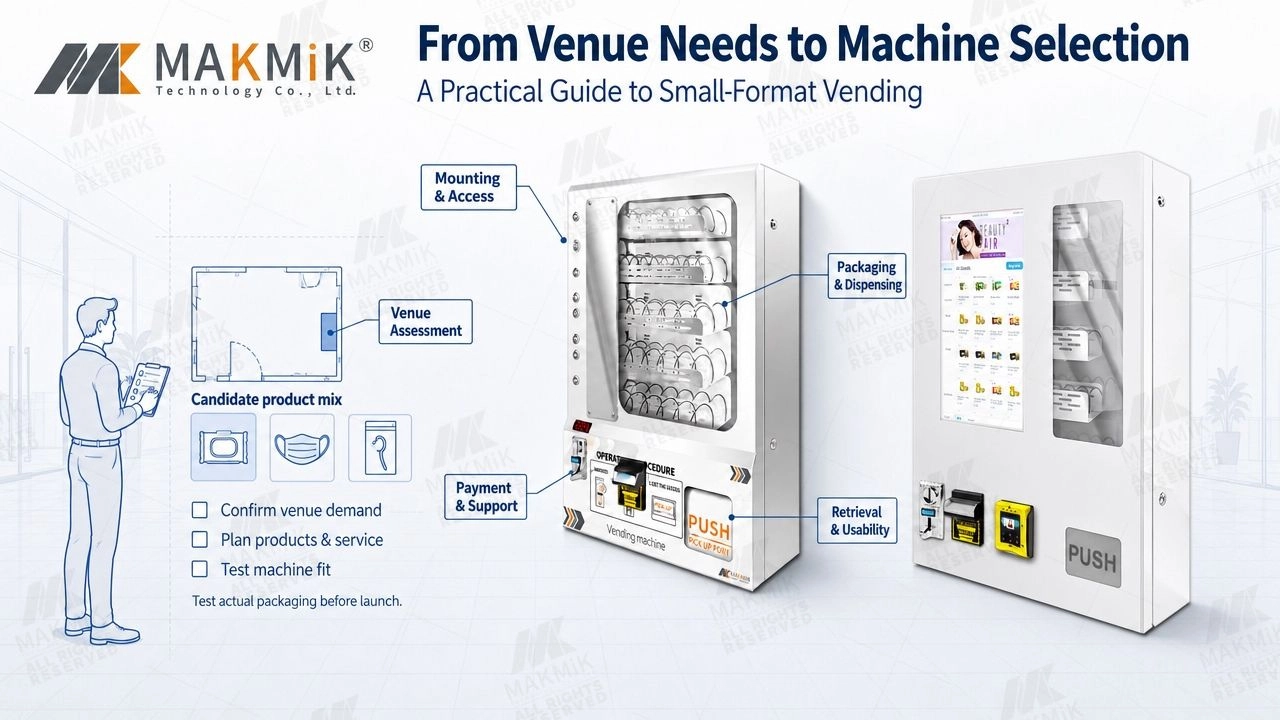
From Venue Needs to Machine Selection: A Practical Guide to Small-Format Vending

Perfume Vending Machine Fragrance Assortment Planning: Local Demand, Nozzle Capacity and Product Rotation

Perfume Vending Machine Payment Reconciliation: Sales, Refunds and Venue Revenue Share

Perfume Vending Machine Site Performance: When to Relocate an Underperforming Machine
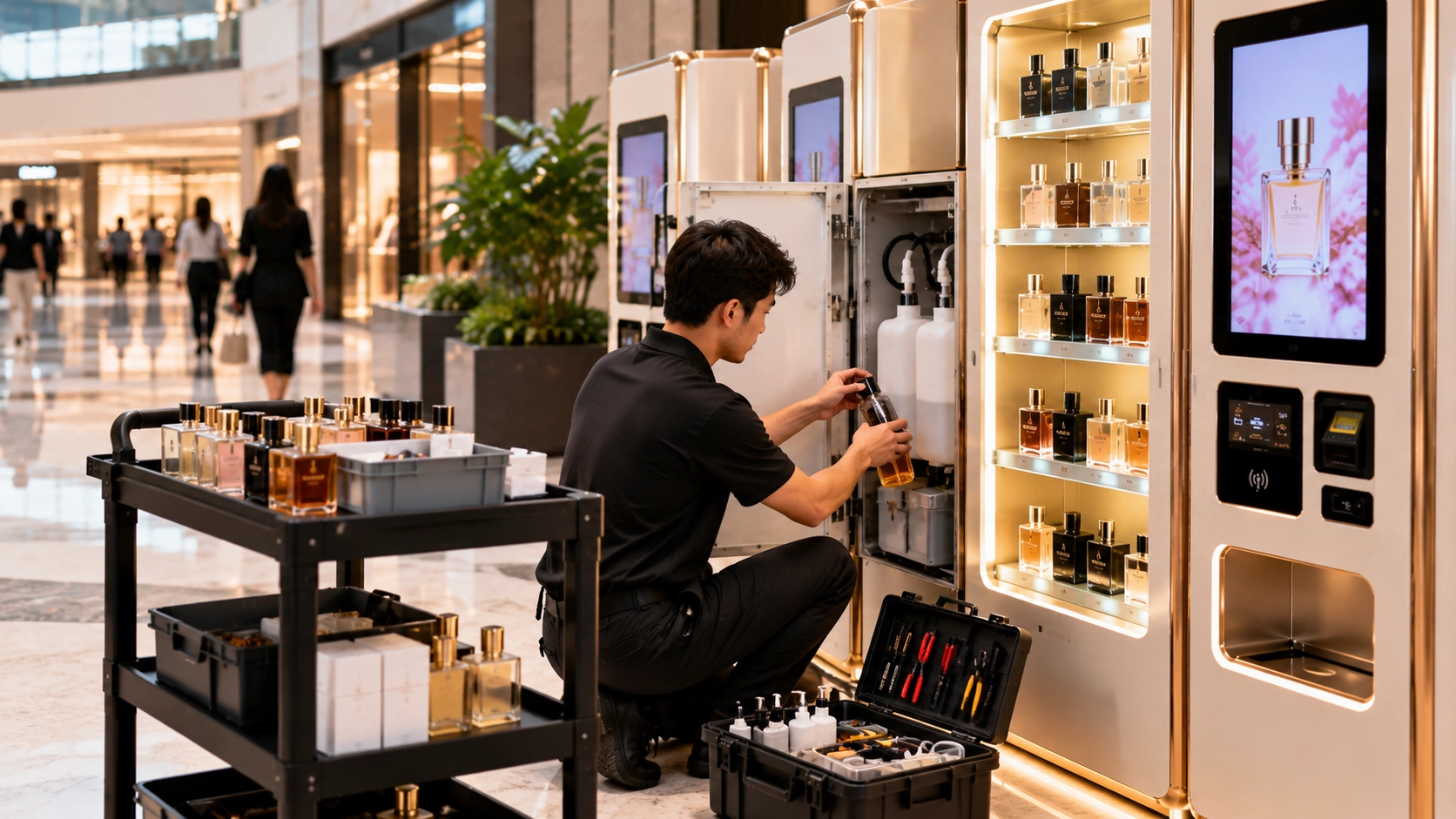
Perfume Vending Machine Refill Route Planning: Labor Costs, Inventory and Stockouts
FAQ
What payment options do your vending machines support?
Our vending machines support various payment methods, including cash, credit/debit cards, mobile payments, and contactless payments.
What kind of technical support do you offer?
We provide 24/7 technical support, including troubleshooting, repair services, and remote assistance to resolve any issues promptly.
How do you ensure the quality of your vending machines?
We adhere to strict quality control processes and use high-quality materials and components to ensure durability and reliability.
What types of vending machines do you manufacture?
We manufacture a wide range of vending machines, including snack, beverage, combo, fresh food, and specialty vending machines.
Distributor
What types of vending machines do you manufacture?
Our extensive catalog includes snack, beverage, combo, fresh food, customized specialty vending machines, and more.
Send my request
Connect with us to schedule a consultation, request samples, or arrange a site visit to see our facilities and capabilities firsthand.
Reach out to us via phone, email, or through the contact form below, and we'll get back to you promptly within 24 hours.
Social Media:
© 2026 MAKMIK | All Rights Reserved.
Facebook
Linkedlin
YouTube
Instagram